
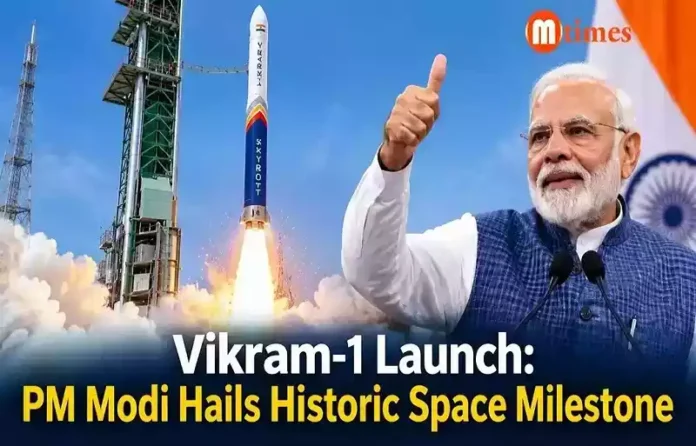

- Vikram-1 became India’s first privately developed orbital rocket to reach space.
- Prime Minister Narendra Modi described the mission as a defining moment in India’s space journey.
- Skyroot Aerospace became the first Indian private company to demonstrate orbital launch capability.
NEW DELHI: The Vikram-1 launch has marked a watershed moment for India’s rapidly expanding private space sector, with Hyderabad-based Skyroot Aerospace successfully placing its first orbital-class rocket into Low Earth Orbit under Mission Aagaman. The achievement makes India one of the few countries where a private company has independently demonstrated orbital launch capability.
Congratulating the team, Prime Minister Narendra Modi said the mission represented “a defining moment in India’s space journey” and highlighted the growing role of private enterprises in driving innovation and expanding the country’s presence in the global space industry.
Vikram-1 Launch Signals a New Era for India’s Private Space Industry
Launched from the Satish Dhawan Space Centre in Sriharikota, Andhra Pradesh, the 24-metre carbon-composite Vikram-1 rocket successfully completed every planned phase of its mission before deploying its payloads into a nearly 450-kilometre Low Earth Orbit (LEO).
The mission demonstrated the maturity of India’s emerging commercial launch ecosystem and showcased the technological capabilities developed by the country’s private space industry.
Prime Minister Modi said the success would inspire young innovators and entrepreneurs to pursue ambitious goals in science, technology and space exploration, adding that increased private sector participation is opening new frontiers for the nation.
Mission Aagaman Successfully Completes All Flight Stages
During the flight, the rocket’s propulsion systems performed as planned.
The Kalam-1200 first-stage solid motor powered the vehicle through the densest layers of the atmosphere before separating successfully. The Kalam-250 second stage and Kalam-100 third stage then continued the ascent, while the Orbital Adjustment Module (OAM) completed the final orbital insertion using a 3D-printed liquid engine.
Designed to carry payloads of up to 350 kilograms to a 450-kilometre orbit, Vikram-1 transported multiple payloads during its maiden orbital mission. Among them was Diamond Lotus, a lab-grown diamond developed by Bengaluru-based Cosmos Diamonds.
The mission also carried a handwritten postcard from the Prime Minister bearing the words “Vande Mataram”, along with handwritten messages from the Skyroot Aerospace team, investors, policymakers and supporters from around the world.
Vikram-1 Launch Strengthens India’s Commercial Space Ambitions
The mission received widespread praise from national leaders. External Affairs Minister S. Jaishankar described the achievement as a historic reflection of India’s innovation ecosystem and the entrepreneurial spirit of its youth. Union Minister of State for Science and Technology Jitendra Singh also termed the successful launch a landmark moment for the country’s commercial space sector.
The successful Vikram-1 launch is expected to accelerate private investment, strengthen India’s position in the global launch services market and encourage the development of next-generation space technologies. It also highlights the impact of recent space-sector reforms, which have enabled private companies to play a larger role in advancing India’s long-term space ambitions.
You May Like
Trending Searches Today |
- Odisha Plans New ABADHA-Like Scheme for Puri Development
- IMD Thunderstorm Alert: 25 Odisha Districts on Watch
- BJD Says It Maintains Distance From BJP and Congress, Not Part of INDIA Bloc
- Puri Records 36.6°C as Heat and Humidity Persist, Coastal Odisha To Face Intense Heat
- West Bengal to Recruit 14,454 Government Post, To Provide Rs 50,000 For Unmarried Women
Amazon Online Shopping