
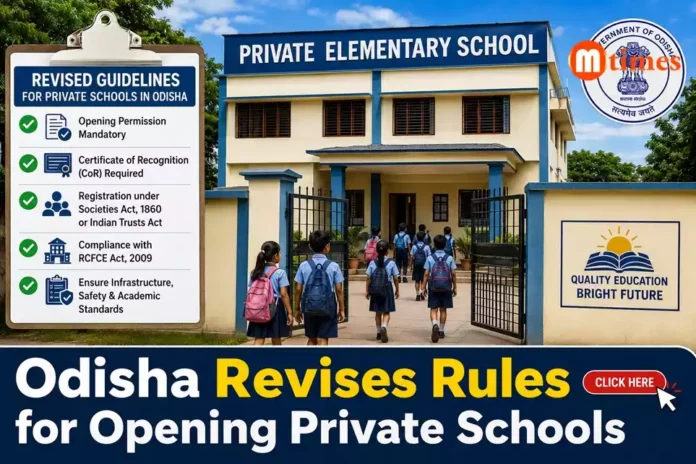

- Private elementary schools must obtain Opening Permission and a Certificate of Recognition before commencing operations.
- The government has removed the requirement for an Essentiality Certificate.
- District authorities will conduct inspections to ensure compliance with the revised norms.
BHUBANESWAR: The Odisha private school rules have been revised following a fresh notification issued by the School and Mass Education Department on January 2, 2026. The new framework lays down updated procedures for granting permission to establish private primary and upper primary schools while strengthening compliance with the Right of Children to Free and Compulsory Education (RCFCE) Act, 2009.
Under the revised guidelines, no private elementary school will be allowed to operate without obtaining both Opening Permission and a Certificate of Recognition (CoR) from the competent authority.
Odisha Private School Rules Introduce New Recognition Process
The notification states that applicants must be registered under the Societies Registration Act, 1860 or the Indian Trusts Act before applying to establish a school. Institutions must also comply with infrastructure, safety and staffing requirements prescribed under the RCFCE Act.
Key provisions of the revised guidelines include:
- Opening Permission and a Certificate of Recognition (CoR) are mandatory before starting a school.
- Applicants must be registered under the Societies Registration Act or the Indian Trusts Act.
- Schools must provide adequate classrooms, toilets, safe drinking water, playgrounds and ramps for accessibility.
- Institutions must appoint qualified teaching and non-teaching staff as per prescribed norms.
- The Essentiality Certificate requirement has been removed for opening elementary schools.
The department clarified that school managements must now apply directly for a Certificate of Recognition under Section 18 of the RCFCE Act instead of obtaining an Essentiality Certificate.
Odisha Private School Rules, Not Easy To Open New
The revised policy seeks to standardise the process of opening private elementary schools while ensuring that institutions meet minimum educational and infrastructure standards before admitting students. Greater emphasis has also been placed on student safety, accessibility and teacher qualifications.
The second-order impact of the new rules could be improved quality assurance in private elementary education, stronger regulatory oversight and better learning environments for students. Removing the Essentiality Certificate may also simplify the approval process while maintaining strict compliance through the Certificate of Recognition mechanism.
Under the revised procedure, applications will be scrutinised before being recommended to the Director of Elementary Education for approval. Once approved, the District Education Officer (DEO) will issue Opening Permission before the commencement of the academic session.
The notification further directs District Education Officers (DEOs) and Block Education Officers (BEOs) to conduct regular inspections and verification of schools. Authorities have warned that institutions violating the prescribed norms will face action under the relevant provisions of the law. The new notification supersedes all previous instructions, while allowing the department to issue additional guidelines whenever necessary.
Also Read | India Japan Annual Summit 2026: Modi and Takaichi to Hold Strategic Talks in New Delhi
You May Like
Trending Searches Today |
- Janmashtami 2026: President Droupadi Murmu and Speaker Om Birla Extend Greetings to People
- Malkangiri Malaria Cases Rise, 7,239 Reported in 7 Months
- Poshan Tracker Monitors 14 Lakh Anganwadi Centres
- Mumbai to Get New-Generation Local Trains With Auto Doors
- Deogarh Man Climbs 58-Ft Tower, Rescued After 6 Hours
Amazon Online Shopping