
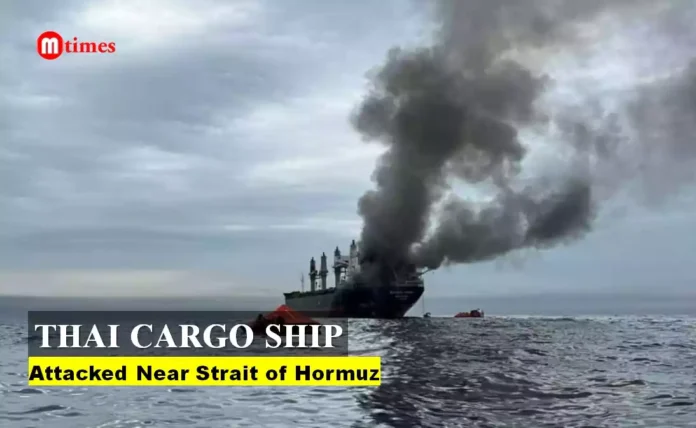

- A Thai cargo ship bound for India was attacked near the Strait of Hormuz, triggering fire and heavy smoke.
- Twenty crew members were rescued, while three sailors remain missing after the incident.
- Rising Middle East tensions are increasing risks to global shipping and energy supply routes.
A Strait of Hormuz cargo ship attack has raised fresh alarm across global shipping lanes after a Thai bulk carrier sailing toward India caught fire following an assault near the strategic waterway. The vessel, Mayuree Naree, was traveling from the United Arab Emirates to Kandla Port when it was hit shortly after leaving port.
Images released by the Royal Thai Navy showed thick black smoke pouring from the ship as life rafts floated nearby. Rescue teams managed to save most of the crew, but three sailors are still missing as search operations continue.
The incident highlights how rapidly escalating tensions in the Middle East are spilling into one of the world’s most critical maritime corridors.
Strait of Hormuz Cargo Ship Attack Disrupts Key Shipping Route
The attacked vessel, a 178 metre bulk carrier owned by Thailand based Precious Shipping Pcl, had departed Khalifa Port in the UAE before entering the Strait of Hormuz.
Authorities say the ship was struck while passing through the narrow passage that connects the Persian Gulf to global sea routes. Iran has claimed responsibility for the strike, though officials say the exact circumstances remain under investigation.
Omani naval forces rescued 20 crew members from the water. Search teams are continuing efforts to locate the remaining sailors.
Security agencies are also examining whether the vessel was linked to a wider series of maritime attacks reported in the Gulf on the same day.
Why the Strait of Hormuz Is Suddenly Becoming a Flashpoint
The attack comes during one of the most volatile periods in the region in recent years.
Tensions surged after Israeli strikes on Iranian targets in late February, reportedly backed by US military support. Tehran responded with missile attacks targeting Israel and countries hosting American military bases.
Iran has repeatedly warned it could disrupt shipping in the Strait of Hormuz, a passage through which roughly one fifth of the world’s oil supply moves every day.
When threats escalate in this narrow corridor, the impact reaches far beyond the region. Energy markets, insurance costs for shipping companies, and global trade routes can all be affected within days.
What This Means for India Bound Trade and Global Shipping
The Mayuree Naree was heading toward Kandla Port in India, one of the country’s major cargo hubs. Any disruption along the Hormuz route immediately raises concerns for Asian importers that rely on Gulf shipping lanes.
Shipping companies may now reconsider routes, increase onboard security, or face rising insurance premiums for vessels transiting the area.
If attacks continue, freight costs for oil, minerals, and industrial cargo moving between the Middle East and Asia could increase sharply.
Missing Crew and Investigation Continue
Authorities say the immediate priority remains finding the three missing crew members and stabilizing the damaged vessel.
The Royal Thai Navy confirmed that investigators are working with regional maritime agencies to determine the full sequence of events behind the strike.
Meanwhile, shipping operators and governments are closely monitoring the situation as the Strait of Hormuz once again becomes a focal point of geopolitical risk.
You May Like
Trending Searches Today |
- Odisha Weather Live Updates: Bay of Bengal Low Pressure May Intensify Into Deep Depression
- CM Majhi Orders Return of Odia Tourists’ Mortal Remains In MP Car Accident
- Odisha Devotees MP Car Accident: PM Modi Announces ₹2 Lakh Aid for Each Deceased Victim
- Seven From Odisha Family Killed After Car Swept Into Drain in Madhya Pradesh
- Ekamra Residency: BDA Opens Online Applications for 496 Apartments
Amazon Online Shopping