
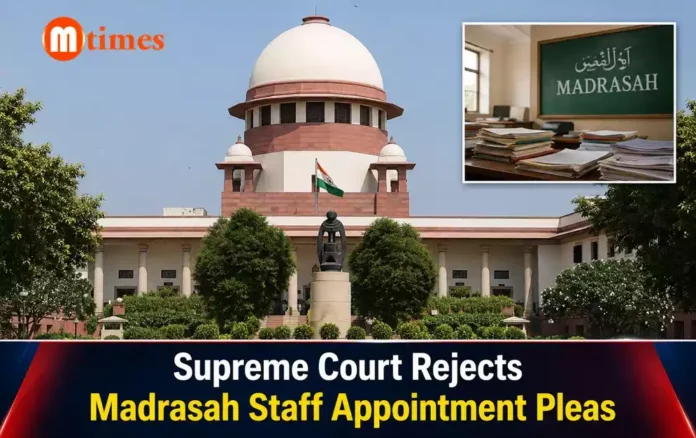

- The Supreme Court dismissed petitions filed by over 350 teaching and non-teaching staff.
- Petitioners sought recognition of appointments in West Bengal madrasahs and payment under the Grants-in-Aid Scheme.
- The court held that the writ petitions were without merit after reviewing representative cases.
NEW DELHI/KOLKATA: The Supreme Court Madrasah appointments case concluded on Monday with the apex court dismissing petitions filed by more than 350 teaching and non-teaching staff seeking recognition of their appointments in various madrasahs across West Bengal. The petitioners had argued that they were regularly appointed and therefore entitled to receive salaries under the West Bengal government’s Grants-in-Aid Scheme.
A Bench comprising Justices Dipankar Datta and A.G. Masih ruled that the petitions lacked merit and rejected all the writ petitions.
Supreme Court Madrasah Appointments Case Ends With Dismissal
The dispute arose after the West Bengal Madrasah Service Commission Act, 2008 was declared unconstitutional by a single judge of the Calcutta High Court, a decision that was later upheld by a Division Bench.
More than 40 writ petitions were subsequently filed by 361 petitioners, claiming appointments as teaching and non-teaching staff in various madrasahs after the High Court’s ruling.
However, the legal position changed when the Supreme Court stayed the Division Bench judgment in March 2016. Later, on January 6, 2020, the apex court upheld the constitutional validity of the West Bengal Madrasah Service Commission Act, 2008 in the Sk. Md. Rafique v. Managing Committee, Contai Rahamania High Madrasah case.
Representative Claims Examined Before Final Verdict
During the proceedings, the Supreme Court examined the records of 13 petitioners, selected pursuant to an earlier direction of the court.
The Bench had indicated that if any one of these representative petitioners successfully established a valid claim, the remaining petitions would also be considered. However, after examining the submissions, the court found that none of the 13 petitioners had demonstrated sufficient legal grounds to succeed.
All Writ Petitions Dismissed
Since the representative cases failed, the Supreme Court concluded that the remaining petitions also lacked merit and dismissed all the writ petitions.
The ruling brings an end to the long-running litigation over the recognition of appointments made during the period of uncertainty surrounding the constitutional validity of the West Bengal Madrasah Service Commission Act, 2008, reaffirming the legal position established by the apex court’s 2020 judgment.
You May Like
Trending Searches Today |
- Delhi CM Orders Probe Against JE, Announces ₹5 Lakh Aid to Animal Activist Jagriti Mishra
- PM Modi Inaugurates ₹169-Crore RBI Data Centre and Cybersecurity Institute in Odisha
- Cyclone Arnab: Red Alert Issued For Six Districts, Odisha CM Reviews Preparedness, Fishermen Warned
- PM Modi to Inaugurate RBI Data Centre in Bhubaneswar on October 25
- India Beat New Zealand by Four Wickets in 2nd T20I, Take 2-0 Series Lead
Amazon Online Shopping